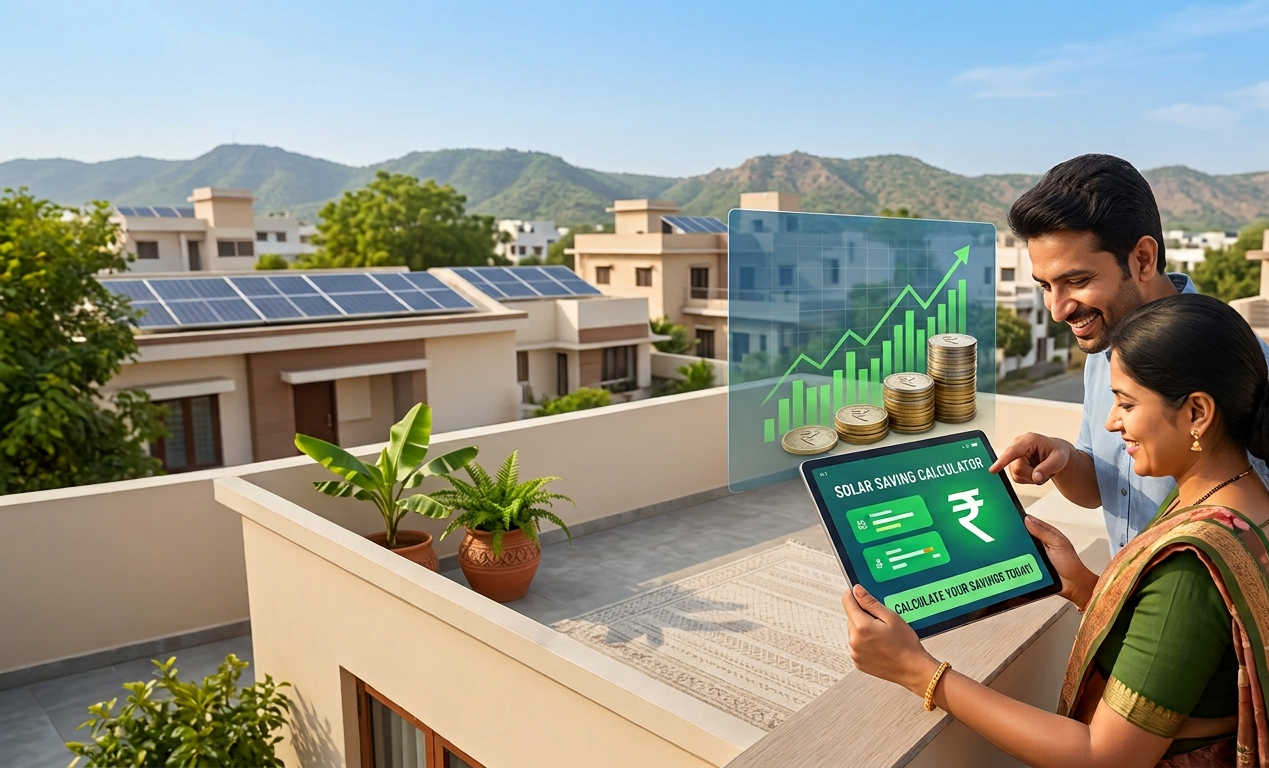
Solar Savings Calculator
A rough estimate of the system size, cost, and payback for your home or business. During a free site visit we give you the exact numbers.
Tariff differs for homes vs businesses. On-grid pricing follows slab rates and includes commissioning.
Roughly 100 sq ft of shadow-free area is needed per 1 kW.
Estimated sunlight in your area: 5.4 peak sun hours/day (South-Central (AP/TG/KA)).
Add your state's rooftop solar subsidy estimate. Central + state subsidy will be included in ROI below.
- Recommended system size
- 4 kW
- Estimated system cost (AGSM Solar)
- ₹3,37,500
- Govt subsidy estimate (Central + State)
- ₹78,000
- Net investment after subsidy credit
- ₹2,59,500
- Annual generation
- 7,884 kWh
- Annual savings
- ₹63,072
- Payback period (after subsidy)
- 4.1 years
- Payback period (before subsidy)
- 5.4 years
Important: Government subsidy is typically credited after installation and commissioning. You should plan for the upfront investment first, then receive subsidy as per scheme process.
Disclaimer: Off-grid systems generally do not receive central/state rooftop solar subsidy.
This is a rough estimate only. Actual figures depend on your exact irradiance, shading, tilt, tariff slab, and DISCOM rules. During a free site visit our engineers give you the exact quotation and system design.
Think of solar as an investment
Over 25 years, your 4 kW system is projected to generate roughly ₹13,17,300 in net savings after cost recovery. That is a tax-free, inflation-hedged return — no other investment gives you a fixed return that also protects you from rising tariffs. Every unit the sun gives you tomorrow costs the same as it does today: zero.
You'll also be helping the nation
India imports over 80% of its crude oil and a significant share of its coal. Every rooftop that goes solar reduces that dependence, lowers grid stress in peak hours, and offsets roughly 162 tonnes of CO₂ over the plant lifetime. Going solar is one of the highest-impact personal contributions to India's 500 GW renewable-energy target by 2030.